by Nadya Logan | Jul 2, 2015 | Lifestyle+Culture
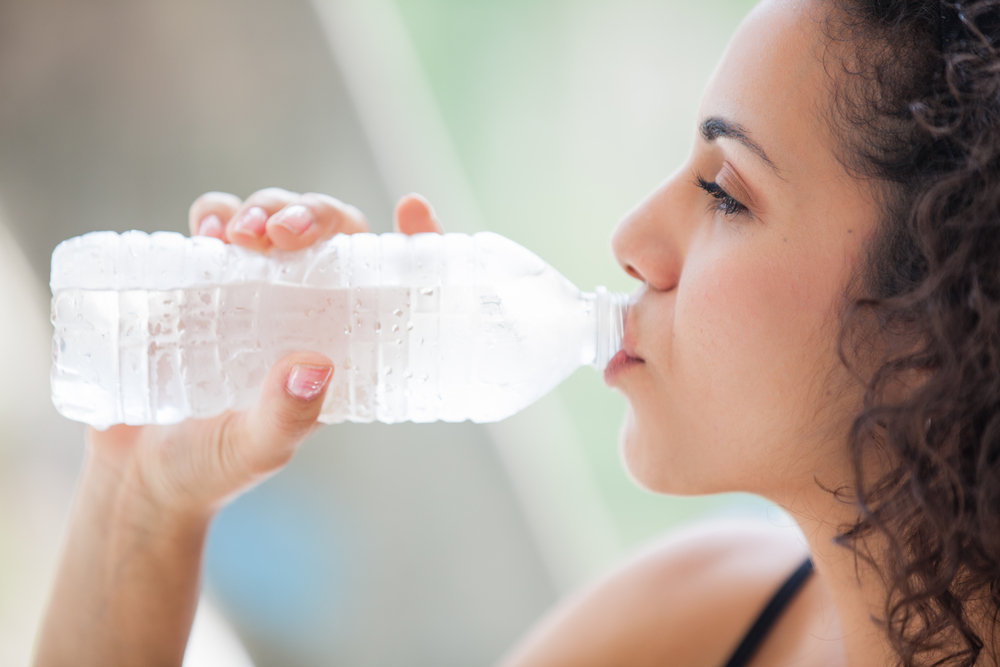
How much water should you drink on average per day? Many people are familiar with the “8 by 8” rule; there is not an answer that applies to everyone. How much water you must intake depends on your health, how active you are, and where you live. Nonetheless, water is essential to good health, and this information may help you find how much water you personally need to consume.
Benefits of Water
Humans cannot live without water—it is known fact. Every system in your body depends on water, and water makes up approximately 60 percent of your body weight. Not drinking enough water can make you dehydrated.
How Much Water Do You Need?
In order for your body to function properly you must consume beverages and foods that contain water. The Institute of Medicine found that the adequate intake (AI) for men is about 3 liters, or 13 cups, and women is about 2.2 liters, or 9 cups, of total beverages per day.
What Influences Water Needs?
Exercise: If you engage in any activity that makes you sweat, you need to drink extra water to make up for any fluids that you lost. An extra cup or two would suffice for moderate exercise, but if you exercise for more than an hour you will need more. How much more water you need depends on how much you sweat during exercise, the type of exercise you are doing, and the duration.
Environment: Hot or humid weather can make you sweat and requires additional intake of water. Heated indoor air can also make your skin loose moisture in the wintertime.
Illnesses or Health Conditions: If you have a fever, vomiting, or diarrhea, you are losing extra fluids. During this time you should drink more water.
Pregnancy or Breast-feeding: Expecting women or women who are breast-feeding need additional fluids, especially when nursing. The Institute of Medicine recommends that women are pregnant drink 2.3 liters, or 10 cups, and those who are breast-feeding drink 3.1 liters, or 13 cups, daily.
Quick Tips
• On average, food provides about 20 percent of total water intake. Fruits and vegetables, such as watermelon and tomatoes, contain 90 percent or more.
• Beverages, such as milk and juice, are composed mostly of water. Even beer, wine, and caffeinated beverages (coffee, tea, or soda) can contribute, but they should not be a major portion of your daily total fluid intake.
• Drink a glass of water other calorie-free or low-calorie beverage with each meal and between each meal.
• Drink water before, during, and after exercise.
by Nadya Logan | Jul 2, 2015 | Lifestyle+Culture
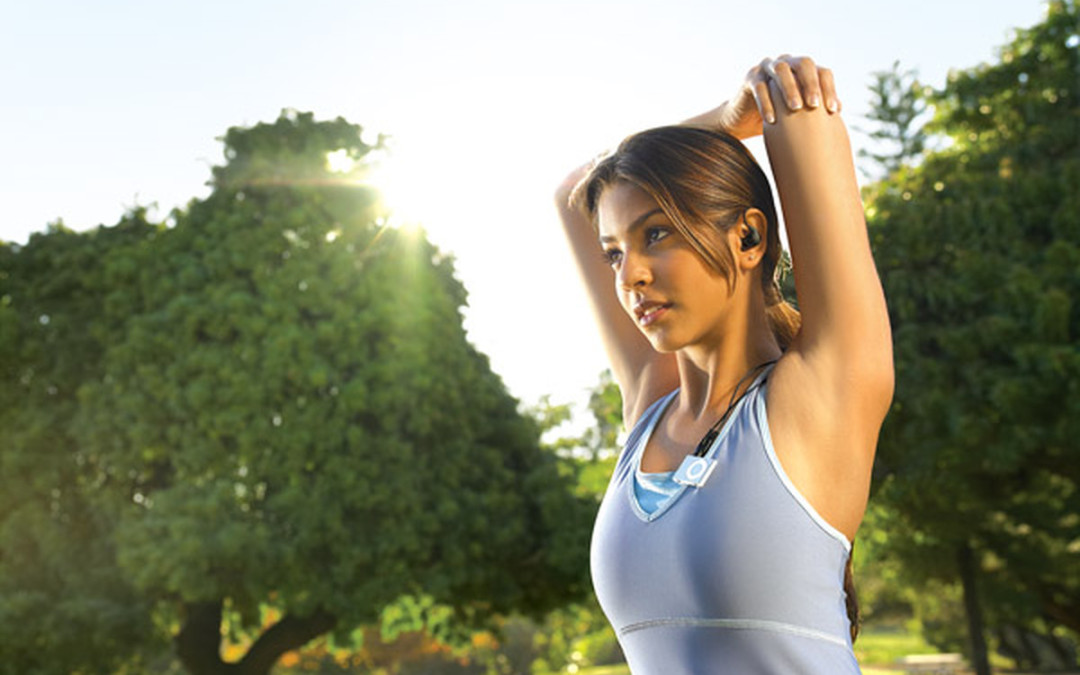
Your life is based on you—what choices you make, what steps you take, what food you intake is all on you! Your exercise routine is not any different. What type of exercise you are able to do depends on your fitness level, the time that you have available, and the goals that you are looking to accomplish. Even if you are not a fitness expert, you know that you are supposed to exercise for thirty minutes a day, five days a week, though what a lot of people don’t know that there three things that you need to fit into your routine. You see, an exercise routine is similar to a diet. In order to get the maximum benefits of your diet, you need to be sure to eat all of your green veggies, bright fruits, and take some time to work in your protein. If your Half-Year Revolution is to begin a routine workout plan or even if you’ve been working out long before July 1st, make sure to incorporate the following: Cardio, Strength Training, and Flexibility.
It’s All About Cardio!
If you go to consult a doctor or a physician about starting a new workout plan, talk to you about cardio.
Cardio is short for cardiovascular, another term used to reference the circulatory system. Cardio exercises increases the heart rate and helps to improve the circulatory system. Examples of such exercises include, but are not limited to: running, swimming, dancing, walking, aerobics, and cycling. Cardio programs should always stay in your personal fitness level; general guidelines for cardio exercise include [1]:
• For health benefits, do moderately intense cardio for 30 minutes a day, 5 days a week, vigorous cardio 20 minutes a day, 3 days a week.
OR
• For weight loss, you may need to do 60-90 minutes of activity several days a week.
Fitwirr, a fitness blog, states that aside from weight loss and improved heart health, cardio exercises
improve brain function and sleep, increases bone density, and alleviates depression.
Popeye Muscular
While performing cardio exercise the only materials that are required are you, you, and you, strength
training requires a bit more. With strength training, you lift weights to strengthen muscles, bones, and
connective tissue. Strength training is just as, if not more, important than weight loss as cardio. With the
assistance of dumbbells, barbells, resistance bands, and any other muscle-strengthening tool you can
get your hands on, you will build lean muscle tissue which raises metabolism and reduces body fat. The
general guidelines for strength training are [1]:
• Choose 8-10 exercises that target the major muscle groups, such as, the lower body, chest, back, etc.
• Beginners should do one set of 8-16 repetitions of each exercise to fatigue. More advanced exercisers can do 2-3 sets.
• Train each muscle group 2-3 non-consecutive days a week.
• Work each exercise through its full range of motion and use good form.
S-T-R-E-T-C-H
If you have ever been to a fitness class you are aware that the first thing done before the workout is
stretching, so why is it often overlooked? Stretching is a definite must-do before any cardio exercise or
strength training is to be done. Stretching is relaxing, and it helps our bodies feel good. It can be done
anytime and practically anywhere, but is most important before and after workouts. The more you
stretch, the more flexible you will become. The general guidelines for stretching are [1]:
• Stretch your muscles when they’re warm.
• Do static stretches with a focus on tight areas.
• Stretch a minimum of 2-3 days a week, 7 days maximum.
• Stretching should not hurt. Be sure to stay within your range of motion.
• Hold each stretch for about for approximately 15-30 seconds, and repeat it 2-4 for each stretch.
Site:
[1] http://exercise.about.com/cs/exbeginners/a/exbasics_2.htm

by Nadya Logan | Jul 2, 2015 | Lifestyle+Culture
1. Eat healthy
Make sure you know what is in your food. Most people look how many calories are in an item, but you should really what you are putting into your body. Avoid: “Artificial Flavors, Enriched Wheat, Hydrogenated or Fractionated Oils, Monosodium Glutamate (MSG), Sugar, High Fructose Corn Syrup, Potassium Benzoate and Sodium Benzoate, Artificial Coloring, Acesulfame-K, Sucralose, Aspartame, BHA (Butylated Hydroxyanisole) and BHT (Butylated Hydrozyttoluene), Propyl Gallate, Sodium Chloride, Soy, Corn, Potassium Sorbate, Soy Lecithin, Polysorbate 80, and Canola Oil,”(Torres, 2013)^[1] or, in short, all processed food items.
2. Do not become discouraged
Just because you haven’t dropped ten pounds in two weeks like you hoped you would, doesn’t mean that you haven’t made any progress! If you get up every day or every other day and do some type of physical exercise during some time and point of your day, you are making progress. All achievements are not visible with the human eye. You may be breathing a bit better, you might be making better food choices, regardless, you are working to become a better, healthier you! Keep up your routines and one day you will wake up to find that you will need to update your wardrobe.
3. Try new activities
If running on a treadmill becomes more of a to-do as opposed to a must-do, it might be time for you to shake up your routine a little. There are plenty of physical activities that can be fun, different, and provide an empowering workout. Depending on where you live, depends on what you may find, but here are a few activities that you could look into…
• Martial Arts: Self-defense and a good workout in one? Sign me up! There is not one standard form of martial arts, leaving you with many options to choose from.
• Swimming: Did you know that swimming increases your muscle tone, strength, and flexibility? Swimming is a great exercise for any gender and age, and why not learn how to prevent yourself from drowning?
• Cycling: Trim a little off of your waistline while getting in touch with your inner child-self. Cycling is another amazing activity that is not gender or age specific, and good for your muscles and heart.
• Dancing: To be or not to be graceful or on time. The benefits of dancing range from, but is not limited to, improvement of your heart, memory, an increase in balance and energy. No wonder why dancing has thrived so much in the recent decades.
4. Set Goals
Goal setting is the number one tool needed to stay motivated! Setting goals and posting your goals, whether it be on dry-erase board, vision board, or on your phone’s lock screen, is a big help when it comes to not only fitness goals, but goals in life in general. Constantly acknowledge the goals that you have set, and pursue them to your maximum human ability. Plan for a diversion so that if one may so happen, you know how to work past it. Planning for an an uh-oh it’s negative, it’s called you being prepared.
5. Get a workout partner
Workout partners can be a great motivational booster and can assist in making exercise more pleasurable. On the contrary, if you do not have the proper workout partner, they may be able to halt your journey. It is important to sit down and explain your goals and plans with your partner, and make sure that you both are on the same page. Otherwise said partner can become a diseased fish in a tank full of healthy ones—simply, a bad seed. A good workout partner can help time pass faster, make you less likely to cancel, be encouraging, and celebrate your success, no matter how big or small it may be.
Source:
[1] www.wakingtimes.com/2013/03/04/20-ingredients-to-memorize-and-avoid-in-any-

by Nadya Logan | Jul 2, 2015 | Lifestyle+Culture
It’s summer time! And while I would love to relax in the Bahamas, the closest I will be getting to acting tropical would be in devouring these delicious vanilla bean coconut cupcakes! Did I mention that the cupcakes are frosted with pineapple cream cheese frosting? It is a sweet treat for you to eat instead of being outside in the unforgiving heat.
This recipe can create 18 servings and for the actual cupcakes you will need:
- 1 14-ounce can unsweetened coconut milk
- 1 vanilla bean, split lengthwise
- 1 3/4 cups all-purpose flour
- 1/4 cup ground macadamia nuts
- 2 1/4 teaspoons baking powder
- 1/2 teaspoon salt
- 3/4 cup butter, softened
- 1 1/3 cups sugar
- 3 eggs
For the frosting you will need:
- 2 tablespoons unsalted butter, softened
- 4 ounces cream cheese, room temperature
- 1 1/2 cups powdered sugar
- 1/4 cup pineapple juice
- Scraped vanilla bean from 1/2 pod (other 1/2 used for cupcakes)
To bake the cupcakes:
- In a medium saucepan bring coconut milk just to boiling; reduce heat. Simmer, uncovered, for 20 to 30 minutes or until milk is reduced to 1 1/3 cups; cool. Meanwhile, preheat oven to 375° F. Line eighteen 2 1/2-inch muffin cups with paper bake cups; set aside. Using the tip of a small sharp knife, scrape out seeds from vanilla bean; set aside.
- In a small bowl stir together flour, ground nuts, baking powder, and salt; set aside. In a large bowl beat butter with an electric mixer on medium to high speed for 30 seconds. Add sugar. Beat on medium to high speed for 1 minute, scraping side of bowl occasionally.
- Add eggs, one at a time, beating well after each addition. Stir in half of the vanilla seeds; reserve other half for frosting. Alternately add flour mixture and 1 cup of the reduced coconut milk (reserve rest of coconut milk for another use) to butter mixture, beating on low speed after each addition just until combined.
- Spoon batter into prepared muffin cups, filling each about three-fourths full. Bake for 18 to 20 minutes or until tops spring back when lightly touched. Cool in muffin cups on wire racks for 5 minutes. Remove from muffin cups. Cool completely on rack.
To create the frosting:
- In a stand mixer fitted with the paddle attachment, beat together all ingredients until completely smooth.
Credit: The original recipe is posted here: http://www.recipe.com/vanilla-bean-coconut-cupcakes/
![STRONG, Inc. [Simple Transitions Render Opportunity Necessary For Growth]](https://www.knowyourstrong.org/wp-content/uploads/2023/04/NewLogo.png)
Recent Comments